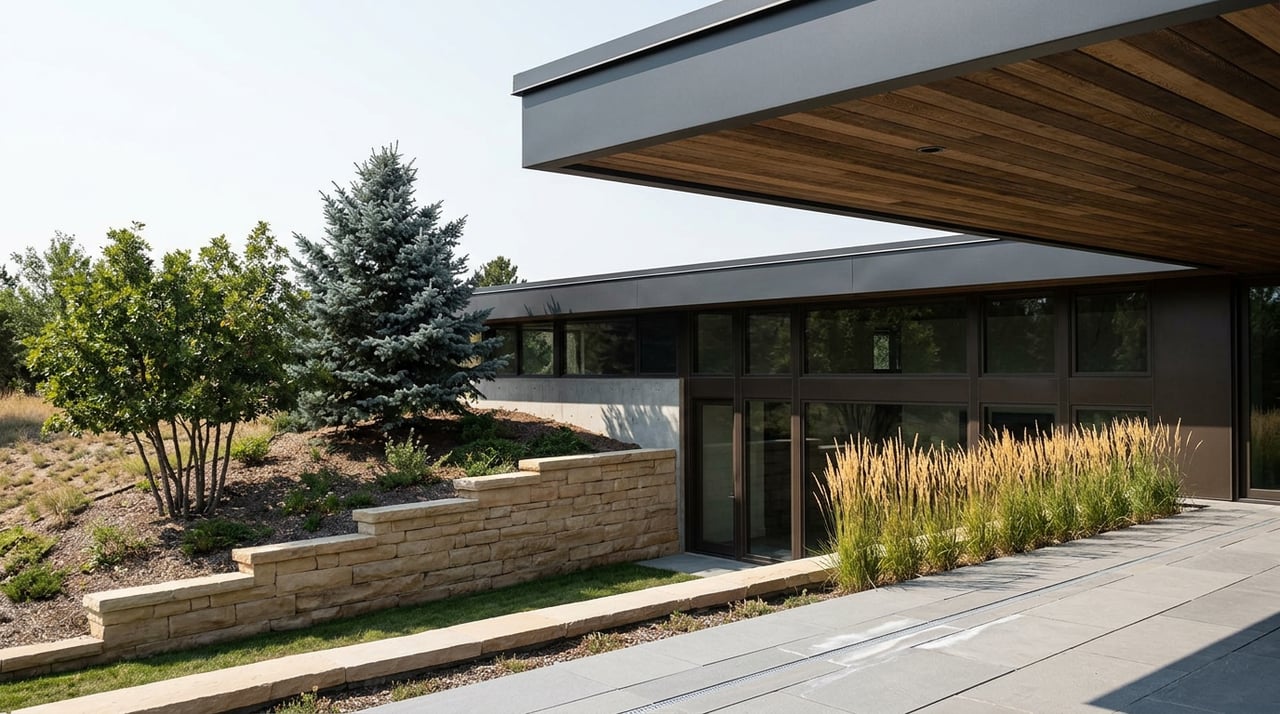
Two houses sit on the same block in Old Town Louisville. One is a coal miner's cottage built around 1910. The other went up in 2021, a full teardown-rebuild on a lot two doors down. Both sit over the same abandoned room-and-pillar workings from the Boulder-Weld coalfield. Only one of them has any legal backstop if the ground beneath it ever gives way.
It is not the new one.
That is the piece of this market almost nobody explains before a contract gets signed, and it inverts the instinct most buyers walk in with. People assume the old house is the risk and the new build is the safe bet. On the question of coal mine subsidence specifically, Colorado's rules run the other direction, and the reason comes down to a single date buried in state regulation.
The coalfield under Old Town
Louisville and Lafayette were built on coal. Mining companies worked seams under both towns from the 1880s through the 1930s, using a technique called room-and-pillar mining, where crews cut tunnels and left coal pillars standing to hold up the roof, then shaved those pillars down as they retreated. Some of those rooms caved in almost immediately. Others are still settling now, a hundred years later, in a slow process geologists call subsidence. State mining officials have mapped workings under Lafayette, Louisville, Erie, Frederick and Firestone at depths ranging from 50 to 150 feet.
Lafayette's own account of its mining era, published by the city, is candid about the outcome so far. Most of Old Town sits over old workings, and relatively little subsidence has actually occurred, because the mines were deep enough and the overlying rock stable enough. But that same history notes that development was restricted for decades in parts of Lafayette, including land near what is now Rothman Open Space, until officials were confident subsidence would not be a problem. The risk shaped where and when the town built for most of the twentieth century. It has not gone away. It has just been quiet.
The date that decides who's covered
Colorado is one of a small handful of states that runs a dedicated subsidence protection program, and it is worth being precise about what it is. It is not insurance in the conventional sense. It is a state trust fund, the Mine Subsidence Protection Program, administered by the Division of Reclamation, Mining and Safety, and it pays out to homeowners whose structures are damaged by the collapse of historic coal workings.
Eligibility hinges on two dates working together. The Division of Reclamation, Mining and Safety defines a "historic coal mine" under the rule as one that ceased operating before 1977. The Colorado Mine Subsidence Protection Program rule limits participation to homes built on that ground under a building permit dated on or before February 22, 1989.
There is a narrow exception written into the regulation: if a builder constructed a home after 1989 in good faith, on land that available maps showed as free of mining, and it was later discovered to be undermined, that home could still qualify. In practice, that exception does very little for Louisville and Lafayette. The coalfield here has been mapped and documented for decades. A builder pulling permits in Old Town today cannot credibly claim they had no way of knowing the ground had a mining history, because the state's own maps for these two towns already show it.
The practical result: the 1910 cottage qualifies. The 2021 rebuild two doors down, on the identical undermined block, does not.
Neither column includes a private insurance option, because there isn't one. No carrier currently sells a dedicated mine subsidence policy in Colorado, and most standard homeowners policies exclude subsidence events outright. The state program is the only backstop that exists, and it is only open to the older half of the market.
What enrollment actually costs, and the detail that trips up closings
For the homes that do qualify, the numbers are modest. A November 2025 report on a briefing to the state's Mined Land Reclamation Board put new enrollment at $305 total, covering a $200 inspection fee and a $35 enrollment fee plus two years of $35 annual bills. After that, participants who keep paying for three consecutive years are done paying for as long as they own the property. Coverage tops out at $100,000 per occurrence, with a $1,000 deductible, and cumulative payouts are capped at the property's fair market value.
The detail that actually matters at closing is easy to miss. Enrollment does not automatically transfer with the deed. State rule dissolves a participant's agreement the moment the property sells, unless a Notice of Transfer is filed with the program administrator. The same November 2025 briefing put the cost of that transfer at roughly $140. If a seller has been enrolled for years and nobody files the paperwork, a buyer can close on a coal-era cottage believing they inherited a protection that quietly lapsed the day the sale recorded.
That is a question worth asking directly, before the inspection period closes: is the home currently enrolled, and will the seller cooperate with filing a Notice of Transfer.
The fund itself is under strain
There is a second layer to this that buyers relying on the program should understand. The same November 2025 board briefing described a trust fund that has been shrinking, not because of a wave of claims, but because the cost of verifying them has risen. The program's administrator told the board the state's own subsurface investigations now run around $3,800 each, against the $200 it collects per enrollee for an inspection.
As Citizen Portal reported, the administrator told the board, "On average, it's costing us somewhere around $3,800 per inspection." The program has been absorbing that gap rather than closing it.
None of this means the program is going away. It does mean a fund built on decades-old federal seed money is being asked to cover rising investigation costs with fee income that has not kept pace, which is a fair thing to factor into how much weight a buyer puts on this backstop over a thirty-year hold.
How a contested claim actually plays out
The clearest illustration of what "the program says no" looks like in practice did not happen in Boulder County. It happened in Colorado Springs, in the Rockrimmon neighborhood, and it is worth knowing because the rules are the same statewide. Homeowners there filed a subsidence claim after their home began showing extensive cracking, and the state's investigation concluded the damage was not caused by the coal mine beneath it. According to The Gazette's 2024 reporting, the state has run 22 subsurface investigations and paid 17 claims across Colorado Springs overall, but had never paid one to that specific block. The same reporting noted the program's pre-1989 cutoff meant it offered nothing to buyers considering the new homes going up nearby at the Creekside at Rockrimmon development.
The lesson isn't that claims get denied often. It's that "the state program covers this" and "the state program will pay this specific claim" are two different sentences, and a buyer should understand which one they're actually relying on.
What to check before writing an offer
- Look up the address against the state's own mapped Louisville or Lafayette undermined areas, published by the Division of Reclamation, Mining and Safety, before assuming either way.
- Ask directly whether the seller is currently enrolled in the Mine Subsidence Protection Program, and if so, whether they'll file a Notice of Transfer at closing.
- Read the soil movement and mine shaft line on Colorado's Seller's Property Disclosure form carefully. It exists precisely for ground like this.
A short FAQ
Does this only affect Louisville and Lafayette, or the whole coalfield? The same eligibility rule applies anywhere in Colorado's historic coalfields, which also run under parts of Erie, Frederick, Firestone and Superior. Louisville and Lafayette simply have the oldest concentration of pre-1977 mining directly under their original town cores.
Is there any way to buy private subsidence coverage in Colorado if my home doesn't qualify for the state program? Not currently. No insurer offers a dedicated mine subsidence policy here, and the standard homeowners exclusion applies regardless of when the home was built.
Does a "good faith" post-1989 exception ever actually apply in these two towns? It's built into the rule, but it requires proof the builder relied on maps that genuinely showed the land as mine-free at the time of construction. Given how thoroughly the Boulder-Weld coalfield has been documented, that's a hard case to make for anything built recently in Old Town Louisville or Lafayette.
Louisville and Lafayette rank among the most desirable small-town addresses on the Front Range for a reason that has nothing to do with what's underground, and for most buyers, that's exactly as it should be. But a home this close to a working man's coal history deserves a buyer who reads the ground the same way they'd read the roof or the foundation. If you're weighing an offer on either side of that 1989 line, Marybeth Emerson can walk you through what the specific parcel history means for your contract before you write the number.
This article is general information, not legal, tax or financial advice. Consult a qualified professional about your situation.