Pull two market snapshots for the same patch of South Boulder and they tell opposite stories. Redfin's data for Table Mesa South, covering the three months ending in May 2026, put the median sale price at $1.2 million, up 25 percent from the same window a year earlier. Movoto's September 2026 read on the same Table Mesa footprint shows the median list price at $1.09 million, down 12 percent year over year, with price per square foot off 13 percent. Both numbers are current. Both describe the same streets. Neither is wrong, and neither is the whole picture.
If you're comparing neighborhoods with a median price as your yardstick, this is the moment to stop trusting the yardstick and start asking what it's actually measuring.
A Market Too Small to Trend Smoothly
South Boulder's Table Mesa pocket doesn't sell enough houses in a given month for a median to behave like a stable trend line. Redfin recorded 13 closed sales in May 2026 for Table Mesa South, down from 18 the year before, and a more recent monthly count for the same footprint showed just 9 homes sold. At that volume, a median isn't tracking demand so much as reporting which two or three houses happened to close escrow that month. Swap one gut-renovated rebuild for one untouched original ranch in the sample, and the median moves double digits without a single buyer changing their mind about the neighborhood.
That's the mechanical explanation for why Redfin and Movoto can both be right. But it only raises the real question: why does this neighborhood have two such different products selling side by side in the first place, and why does the mix keep shifting?
The Neighborhood Was Built as One Product and Is Selling as Two
Table Mesa and the surrounding South Boulder grid went up in the 1960s and 70s as a fairly narrow set of house types. A drive-by survey turns up five recurring forms: the simple ranch, the split-level, the tri-level, an occasional gambrel-roofed barn shape, and a scattering of two-story gables. Original sizes ran small by today's standards, from just over 1,200 square feet up to about 2,900, with the smallest ranches, the ones built without a garage or basement, often under 1,000 square feet. Basements and garages in a lot of these houses were added later, sometimes decades after the original build, which is worth remembering the next time a listing photo shows a finished lower level. The foundation age and the main floor's age are not always the same fact.
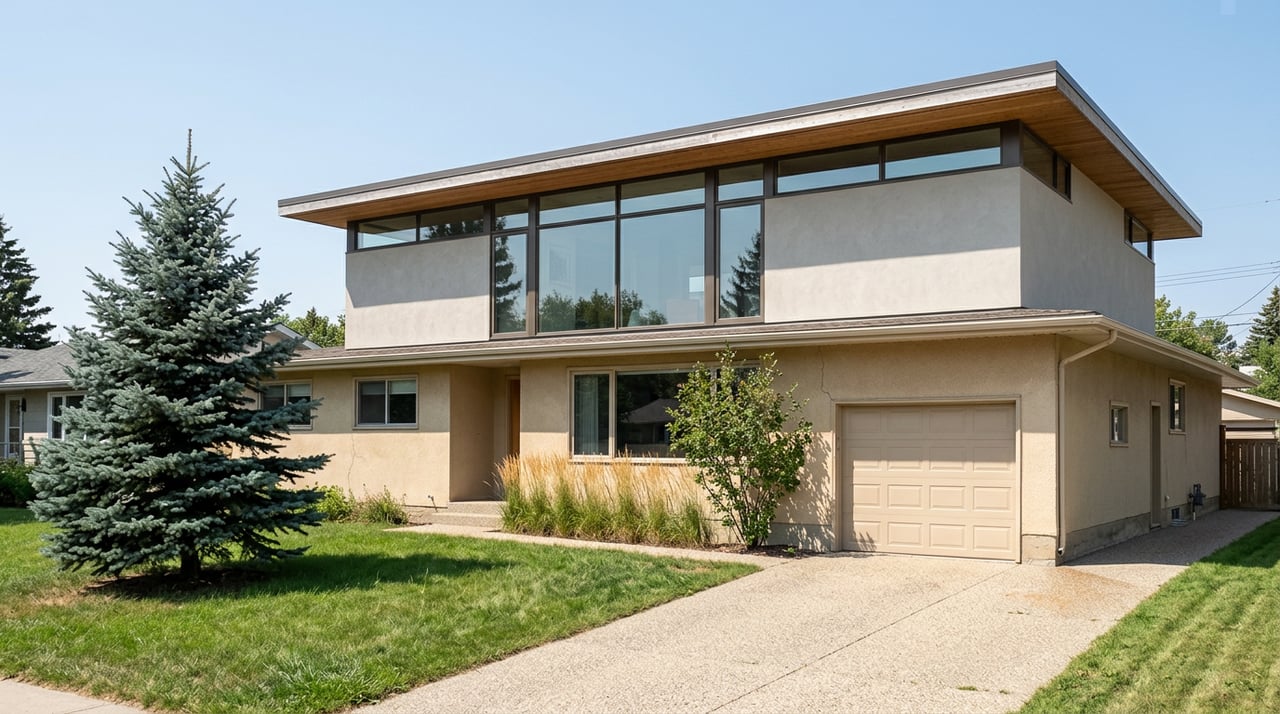
For years, the standard renovation target was the kitchen, since 1960s builder kitchens were tight, cut off from the rest of the house, and never designed around an island. The bigger money move, though, has been the second-story addition, usually a primary suite chasing a Flatirons view that the original single-story ranch never captured. Local renovation and rebuild activity in Table Mesa has trended toward exactly this: partial and full second-story pop-tops, larger geometric expansions, and complete rebuilds that keep something of the original mid-century footprint while doubling the livable space. Those are the homes pulling the price-per-square-foot ceiling up. The untouched originals are the homes anchoring the floor. A single median has to average both, and which one dominates in a given month is close to a coin flip in a market this small.
Why Not Every Ranch Can Become a Pop-Top
Here's the part that doesn't show up in a portal listing. Whether a given South Boulder lot can legally support that lucrative second story has almost nothing to do with the owner's budget and almost everything to do with which direction the street runs.
Boulder's solar access ordinance protects a four-hour window of winter sunlight for the property next door, measured against the sun's position on December 21st, using a hypothetical 12-foot or 25-foot "solar fence" set at the property line depending on the zoning district. On the east-west mesa streets that cross parts of South Boulder, Chautauqua, and Mapleton Hill, a north-facing addition mostly throws its shadow into the street rather than a neighbor's yard, which gives those lots more room to build up. But the stretch of South Boulder between Table Mesa and Viele Lake runs a tighter north-south grid on smaller parcels, commonly in the 6,000- to 7,000-square-foot range. On those lots, a second story casts its shadow directly onto the northern neighbor's property, and it doesn't take much height before the addition crosses the line.
Layer Boulder's newer Compatible Development rules, the ones locally nicknamed "pops and scrapes," on top of that solar restriction and the math gets tighter still. With side setbacks as narrow as five feet on many of these smaller lots, the combined bulk-plane and solar-shadow limits can push a compliant second-story ceiling to under six feet at the wall's edge, forcing the addition to shift several feet toward the lot's south side just to clear the neighbor's solar rights. Under the older rules, Boulder's classic pop-top was a straightforward partial extension mirroring the roofline below. Under the current combination of rules, the same addition on a north-south lot often has to get smaller, get pushed south, or get redesigned entirely before the city will issue a permit.
That's the real mechanism behind the split market. Two ranches on the same block, built from the same catalog of house types in the same decade, can have completely different renovation ceilings depending on which way the lot faces. One becomes a $1.09 million original sale. The other becomes the base for a rebuild that sells for a meaningfully higher number per square foot two years later. The median treats them as comparable inventory. They aren't.
| Data point | Window | Figure | Source basis |
|---|---|---|---|
| Boulder citywide median sale price | 3 months ending July 2026 | $981K, up 9.0% YoY | Citywide MLS-based reporting |
| Table Mesa South median sale price | 3 months ending May 2026 | $1.2M, up 25% YoY | 13 closed sales |
| Table Mesa median list price | September 2026 | $1.09M, down 12% YoY | Current active listings |
| Table Mesa price per square foot | September 2026 | $636, down 13% YoY | Current active listings |
What This Means for a Listing You're Looking at Right Now
If you're comparing a South Boulder property against the neighborhood's advertised median, the more useful question isn't "is this priced above or below the median." It's "which of the two markets is this house actually competing in." An original ranch with its original footprint is going to comp against other original ranches, and its ceiling is set partly by whether its lot orientation would even permit the kind of addition that unlocks the higher price band. A house that's already been popped, scraped, or rebuilt is competing against other renovated stock, where the relevant comparison is finish quality and design, not raw square footage.
Before assuming a smaller South Boulder house has upside through a second-story addition, it's worth finding out which side of an east-west or north-south street it sits on, and whether the lot's dimensions leave room under Boulder's solar access rules for the kind of addition you're picturing. The city's own solar access guide and worksheet lay out the calculation, and it's a five-minute check that can save months of a design process aimed at something the lot was never going to support.
The same house-by-house logic applies below ground. Boulder County sits in the EPA's highest radon risk category, and state disclosure law requires sellers to share any radon test results they know about, but it doesn't require testing in the first place. Boulder County's own guidance is explicit that soil conditions vary enough from one lot to the next that a clean test from the house next door tells you nothing about the one you're buying, particularly in a stretch of the neighborhood where basements were added to different houses in different decades. Every lot gets its own solar analysis. Every house deserves its own radon test for the same reason.
A Short FAQ
Is South Boulder's housing market actually cooling off? Not by the citywide measure. Boulder overall posted a median sale price increase over the three months ending in July 2026. What's cooling, or at least what's showing up as lower list prices in Table Mesa specifically this September, is more likely a mix effect from a small sample of homes than a broad drop in buyer demand.
How do I find out if a specific South Boulder lot can support a second-story addition? Start with the property's zoning district and its orientation relative to the street grid. The City of Boulder's solar access guide explains the fence heights and shadow calculations by district, and a licensed architect or designer familiar with Boulder's Compatible Development rules can run the analysis before you commit to a renovation budget.
Does a finished basement mean the house was built that way? Not necessarily. A number of South Boulder's original 1960s and 70s ranches were built without a basement or garage and had them added later. Ask when the foundation work was done, not just when the house was built.
If you're weighing a purchase or a sale in this stretch of Boulder and want a read on which side of that split market a specific property sits on, Marybeth Emerson can walk the comps with you street by street. Schedule a consultation to talk through the numbers before you make an offer or set a list price.